Showing posts with label Jewish history. Show all posts

Sunday, April 21, 2013

The Dachau Concetration Camp: Memorials

Reflection was needed during and after our visit to make sense of what we had seen and learned.  As it stands today, the camp is preserved as a lasting reminder of the horrors of the Holocaust and as a memorial to those who lost their lives there.  It exists as a cautionary tale of what could happen if power is left unchecked.  It reminds us of the destructive effects of fear and hatred.  It reminds us to study history to protect our future.  


There are several memorials and places for reflection in the roll call area.  This sculpture, as mentioned in the video from a couple days ago, was created by a Yugoslavian survivor of Dachau.  It depicts prisoners jumping or falling into barbed wire.  Some prisoners resorted to this to escape the terrors of the camp.  This memorial was dedicated in the 1960s.  

 
In the Jewish faith, it's customary for visitors to leave small stones on graves. I read a little bit more about this custom here and here.  This gesture meant a lot to me.


"Think about how we died here."  


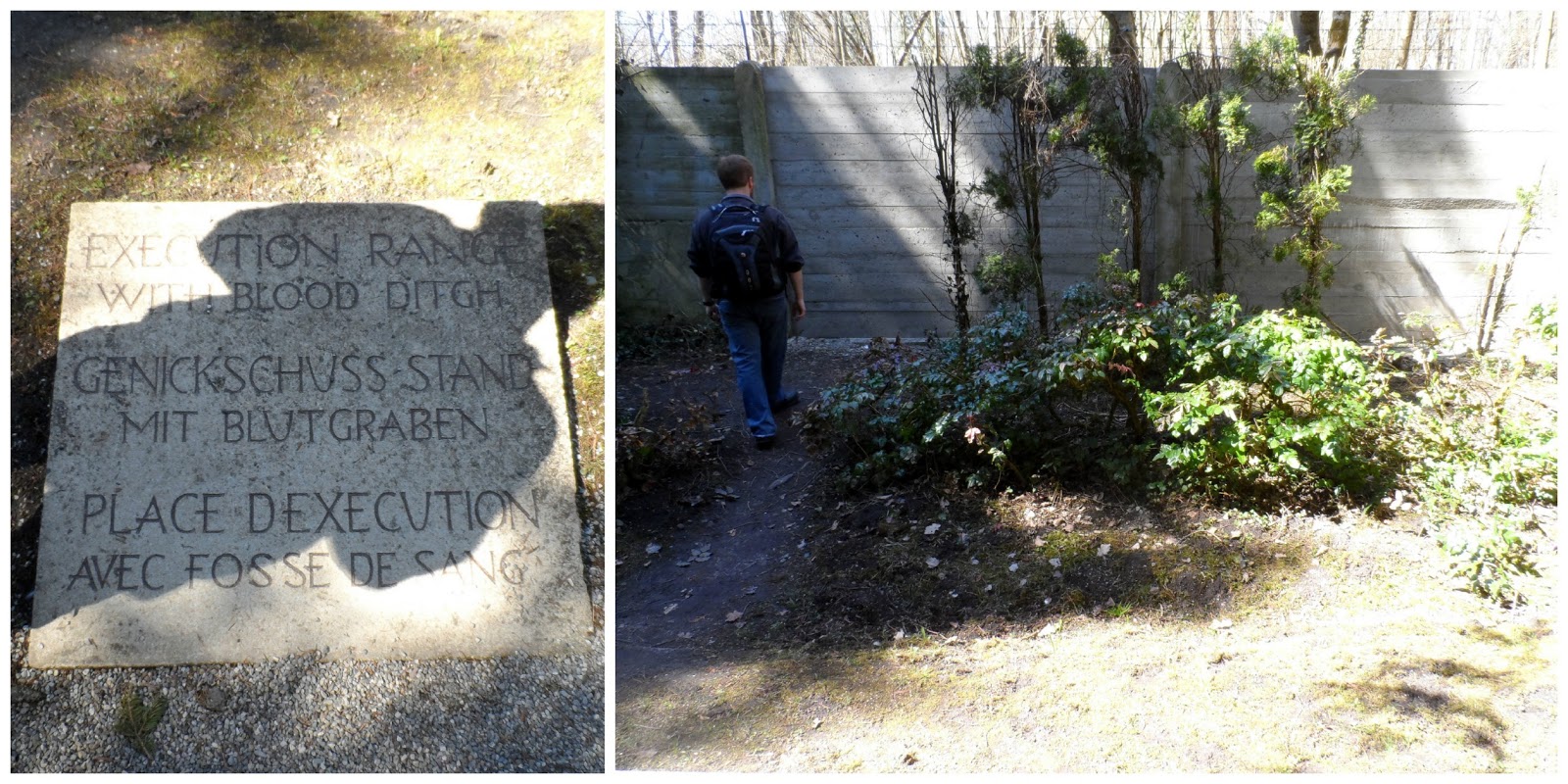
Memorials surround the crematorium. The ashes from the crematorium were buried in piles behind the building and in the nearby wooded area.  Memorials mark the ash pits and the execution range.


"Over six million Jews fell victim to the National Socialist (Nazi) reign of violence." 


The Jewish memorial, set behind the prisoners' barracks, is a place for quiet reflection. 
There are also Catholic and Protestant memorials, and a convent with a chapel is also located on site. 

*

With everything going on in the world, take a moment and reflect too.  

Saturday, April 20, 2013

The Dachau Concentration Camp: The Crematorium

A bridge separates the crematorium area from the rest of the camp.


Although thousands of prisoners died at Dachau (~32,000 were documented), Dachau was not primarily a death camp.  More prisoners died from malnutrition, over-working, and disease than in the gas chamber.  But when walking through the gas chamber and the crematorium area on the same path that unsuspecting prisoners walked, this fact doesn't seem to matter.

 
(*Disclaimer: The video is shaky because I didn't want to show the faces of other visitors.)

We talk about the Holocaust as the systematic killing of people who were deemed a threat by Nazi party officials.  Taking the walk from room to room made this point perfectly clear.  Each room had a purpose.  Each aspect of the building was intentional.  What I experienced was a factory of death, and it's something that I'll always remember.    


1. The waiting room
2. The undressing room
3. The gas chamber
4. The room to stack bodies before cremation 


The wooden beams used for hangings are visible here.  These ovens worked day and night, and as the war progressed, the ovens' capacity could not keep pace with the number of victims.  Corpses were stacked in and outside of the crematorium.  Dead bodies filled boxcars leading into Dachau.  After American troops liberated the camp in April of 1945, they forced German citizens to view the dead.


Sources

If you're interested in seeing photos and videos of the camp during the war and its liberation, you can look here:

United States Holocaust Memorial Museum
Dachau Memorial Site
Third Reich in Ruins (Dachau then and now)

*

My final post will cover the memorials at Dachau.  

Friday, April 19, 2013

The Dachau Concentration Camp: The Main Camp

On the train from Munich to Dachau, the knot in my stomach tightened.  When Ben whispered, "These are probably the same train tracks..." I had been thinking the same thing.  This past Sunday, we were able to visit Dachau and to leave.  Seventy years ago, most riders on the same tracks did not have the choice.

*

General Facts

- The first concentration camp was set up in Dachau, Germany shortly after Hitler became the Reich Chancellor in 1933.  Dachau served as the model for all additional camps built, and it was a training site for members of the SS.

- Jews, Jehovah's Witnesses, Sinti and Roma (European gypsies), homosexuals, Soviet prisoners-of-war (POWs), priests, political opponents, resistance fighters, and other people deemed as social outcasts were imprisoned at Dachau.  The majority of the prisoners came from Poland. 

- As originally built, Dachau did not have the capacity to house the number of prisoners eventually sent there.  In 1937, prisoners were forced the enlarge the camp themselves.

- As the war progressed, more people were sent to Dachau, and the camp became grossly overcrowded.  In addition to malnourishment, over-working, and the gas chamber, a typhus outbreak contributed to an estimate 32,000 deaths at Dachau during the twelve years the camp was in operation. 

- When the crematorium at Dachau could not keep up, prisoners were sent to Hartheim Castle in Austria for execution. 

- Dachau was liberated by American troops on April 29, 1945.  Some 32,000 people were liberated.


These half-buried train tracks leading to the entrance of the concentration camp (Konzentrationslager, or KZ) were uncovered within the past ten years.  They end as abruptly as they appear.  The SS headquarters for the camp were located in the yellow building on the right side.  Now, the building houses the local riot police.    

Turning around, you see the entrance gate to the camp, which is called the Jourhaus.


The gate that met the prisoners as they entered the camp bears the words, "Arbeit macht frei."
Work makes you free.


Once prisoners entered the camp, they were processed in the maintenance building.  The above collage depicts the Shunt Room, or Schubraum.  The incoming prisoners were separated from soldiers and German-speaking prisoners by the tables in the middle of the room.  On desks like the one pictured on the right, prisoners who could speak German were tasked with writing down the names, birth dates, birth places, personal possessions and other pieces of personal data of each new prisoner.  New arrivals left this room naked and proceeded to the showers.


The "bunker" was used as the camp jail.  SS officers put defiant prisoners in the cells to separate them from influencing other prisoners, and for punishment, torture, or execution.

On the 70 degree day that we went to Dachau, this building felt absolutely freezing.  I could not stay for more than a couple minutes, and I could not imagine it in the winter. 


The foundations of the barracks that housed the prisoners are numbered and run down either side of the tree-lined walkway.  The camp had 34 barracks, and as the war progressed, the camp became more overcrowded.  A watchtower can be seen in the background.  Prisoners were placed in the barracks according to their usefulness; the more useful the prisoners were, the closer they were placed to the roll call area at the center of the camp.  Interesting note: one of the barracks functioned as a brothel.  Female prisoners from a nearby camp were forced to work in the brothel to supposedly help increase the productivity of the prisoners at Dachau.  It seems like there was no end to the degradation of the prisoners. 


More posts are forthcoming. 

Friday, April 12, 2013

This Sunday

 
This trip in two days does not feel real to me yet, but I know that it is a trip I need to take.

Wednesday, January 9, 2013

Wiener Neustadt and the Inescapable Past

When we visited our friends in Wiener Neustadt over the holiday break, they gave us a tour of the town.  The weather was absolutely miserable; the rain fell at such a pace that my glasses could not be kept dry despite my hood or my annoyance.  That easily has to be one of my biggest pet peeves.  Why hasn't someone invented a solution to this yet?  (And don't just say contacts.) 

We didn't see the town on one of her better days, but we were left with impressions that are worth sharing.


In the Stadtpark (city park), Johannes and Amy pointed out that the city of Wiener Neustadt had been fortified several times and they showed us portions of the different city walls within the Stadtpark.  Then, we came upon these gravestones from the twelfth and thirteenth centuries that were displayed in front of one of the walls.  As the story goes, there used to be a bustling Jewish community in Wiener Neustadt until the reign of Emperor Maximillian in the fifteenth century when he ordered Jews out of the city and converted their synagogue into a Catholic church.  In 1846, city workers who were digging around the city walls uncovered these tombstones, evidence of a more tolerant past toward Jews in the city.     


We passed this building as we exited the Stadtpark.  Remember when I wrote about the Altes Rathaus in Munich, the setting for a hate-filled speech by Goebbels that led to Kristallnacht that has been transformed into a safe, innocent toy museum?  Well, this building shares a similar fate.

Beginning in 1938, this building was used as an office for the Gestapo.  It belonged to Jewish people, and was seized as were many other Jewish-owned properties in Austria and elsewhere in Europe.  Soon after establishing themselves in Wiener Neustadt, around ninety Jews and other political opponents of the Nazis were arrested over the course of two days.  Many of these people were later transported to Dachau (next to Munich) and other concentration camps after being tortured and abused here first.   

Now, it's called the Europahaus and it houses a kindergarten and a youth hostel. 

I'm torn when thinking about this.  No amount of remodeling or renaming can hide history.  I don't think that buildings such as the Altes Rathaus in Munich or the Europahaus in Wiener Neustadt should be torn down.  That would be a denial of history.  At the same time, we can't expect Germans and Austrians to keep the buildings as they were in the '30s and '40s.  That would make it seem like the people haven't moved on, and from what I know, most people here want to leave that history far behind them.  But, repurposing these buildings into innocuous establishments, like toy museums and kindergartens, also feels like a slap in the face.

The United States isn't exempt from this: plantations, Native American villages and burial grounds, lynching trees, the fence where Matthew Shepard was left to die, a movie theater in Colorado, an elementary school in Connecticut.  The list goes on.  What should be done with these places?

How do we successfully acknowledge the past as well as heal and grow as time goes on?