Monday, December 31, 2012

Our Holiday Break in Wiener Neustadt

After exploring Vienna, we accompanied Johannes and Amy back to Wiener Neustadt. 

The next day, we had to trek to the grocery store for lasagna ingredients, cookie decorations, and other assorted products.  The white stuff was everywhere.


The snow called for Russian-inspired headgear, which I LOVED.  I just learned that this type of hat is called an ushanka.  The more you know... 


Be careful.


This is a glimpse of Ben in the future.  We used the buggy to carry groceries.


Amy had Leinie practice his tricks during our stay.  She gave her commands and praise in German.  


We took the opportunity to use an oven (our kitchenette here is just two burners) to cook lasagna. 

And, by "we," I mean I sat, did crosswords, and took pictures.  


For lunch one of the days, we had this delicious Jause spread.  To Jaus, you take a piece of bread (in this case, homemade by Amy); coat it with spread, jam, or butter; and layer it with meats, cheese, pickles, tomatoes, peppers, and whatever else.  We each had a little cutting board to prepare our Jause.  So good. 


Christmas cookies with decoration FAILS.   


On Christmas Eve, the Christkind came!  Somehow, when Amy, Leinie, Ben, and I were locked in their bedroom, the Christkind (literally, the Christ child) visited the apartment.  When he left, a bell rang, and we knew it was safe to come out.  He left us all presents!  

For Austrians, the primary day to celebrate is the 24th.  It's a day for the family to be together, for the Christkind to bring presents, and for the family to go to church.  While some Austrians decorate with Santa Claus, it seems like most people here do not like Santa, whom they call the Weihnachtsmann (the Christmas man).  They associate Santa with America and with consumerism.  You can see the ads for Coca-Cola at train stations and around town, and I saw a few ads defaced.  Instead, their tradition is that the Christkind brings presents, and that's why we had to hide in the bedroom for Johannes, ahem, the Christkind, to visit the apartment and then leave.        


We played card games in which I dominated for quite a while, and hey look!  Trachten! 
They gave us a little fashion show.


For lunch on Christmas Day, we went to Heurigenlokal Wittmann in nearby Neudörfl. The wreath around the sign means that they're open for business.  It's in the Austrian state of Burgenland, where much of Austria's wine is produced.  Basically, it's a winery that serves hot and cold food.  This type of restaurant can be found in Burgenland and in Styria.  Another type of restaurant from the same area in Austria that we have yet to visit together is a Buschenschank.  There, the focus is more on the food. 


Don't be deceived; the food was very tasty!  I had hühner schnitzel and Ben had beef goulash. 

Johannes and Amy, thank you for having us and for showing us Vienna and Wiener Neustadt!  You both were wonderful hosts and we're excited for more adventures in the spring! 

Sunday, December 30, 2012

A Day in Wien

A few days before Christmas, Ben and I met our friends, Johannes and Amy, in Vienna.


 Children had the day off from school.  This is how they spent some of their time.


The Christmas Market in front of Vienna's Rathaus (city hall) was absolutely packed with hordes of children and tourists, and a sprinkling of locals.  Its aromas were cinnamon, glühwein, and festivity.    

We took a ride around Ringstraße on my first Straßenbahn to Hundertwasserhaus, a unique apartment building in Vienna.  From the website and edited by me:
"The Hundertwasser House was completed in 1983-1985...The flats have various [floor] plans. There are one-story and two-story flats.  Many apartments have protruding balconies or pergolas and loggias... What was taken away from nature by the construction of the building was restored on the roofs. The living, uneven floor in the public areas of the buildings amounts to a rediscovery of human dignity, which was taken from people in an urban development of flat surfaces. The mosaics on the walls, in the stairways and in the corridors were created by the workers along with the tiles in the kitchens and in the bathrooms, which were laid irregularly to avoid the grid system... With this house, Hundertwasser proved that human architecture more in harmony with nature is possible within the regular construction time, within the financial budget of a public project, and within the current building laws without any special permits."

Afterward, we visited the Hundertwasser Cafe, complete with table toys and real heiße Schokolade.   


I'd say this statue is about opulence, but this photo is all about Leinie.  


This is the facade of the Secession Art Gallery near the Naschmarkt.  The building itself was beautiful with its golden dome, and the Medusa-esque faces above the entryway were cool.


For lunch, we visited the famous Naschmarkt.  Amy and Johannes shopped for a few groceries first, and we had the opportunity to browse stands selling flowers, produce, wine, meat, fish, and other goods. 


Next, we walked down a pedestrian shopping street, but not before Leinie made friends with another Cocker Spaniel puppy.  


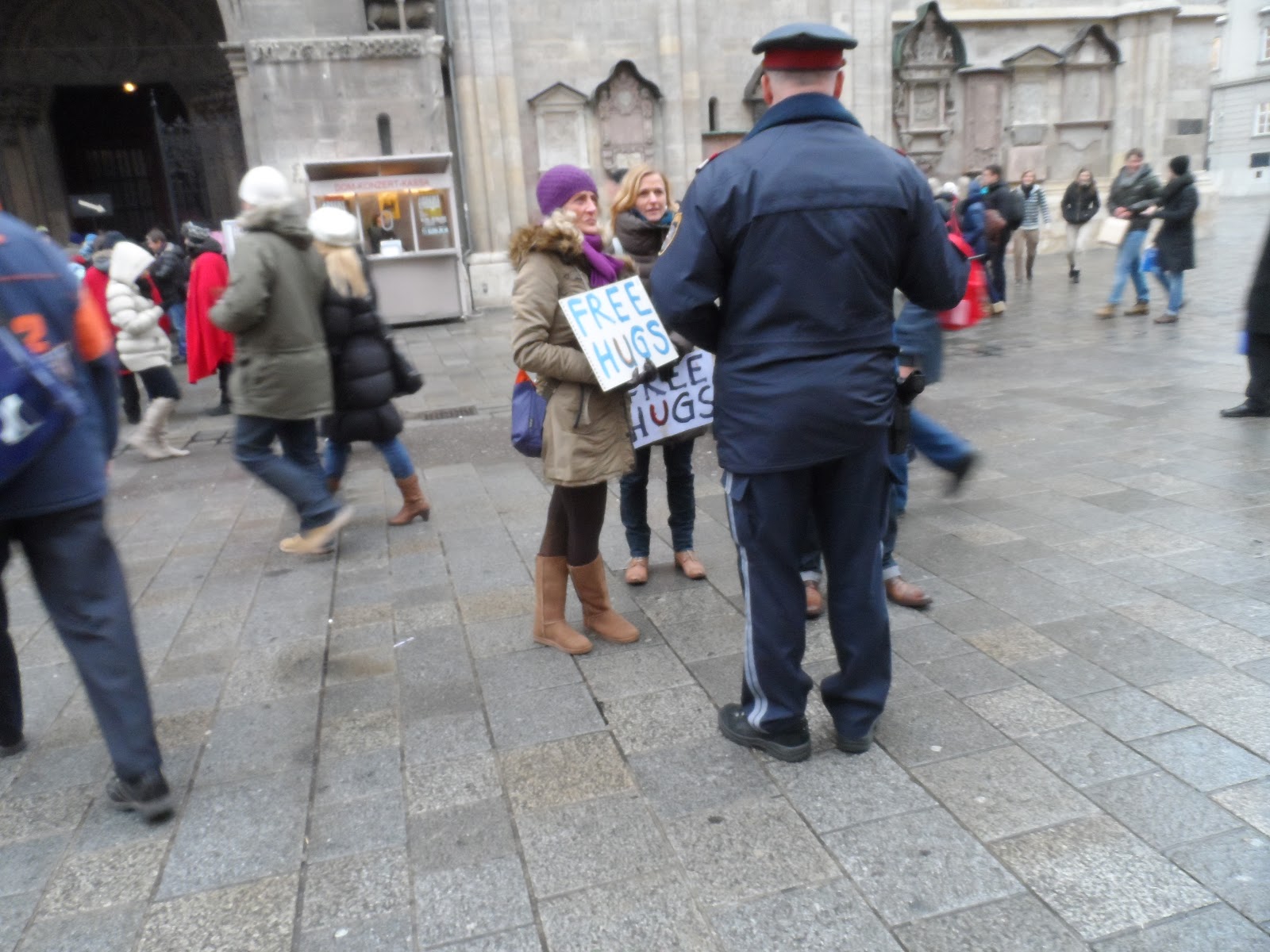
This is St. Stephan's Cathedral and these are some people being told not to give free hugs in public.
I told Ben that he looked like the one Winklevoss twin in The Social Network.

Vienna, I feel like we barely scratched the surface.  We may have to visit you again in the spring. 

Wednesday, December 26, 2012

Color Yourself Fascinated

Here comes the final installment of my year-end series on the Ten Most Fascinating Aspects of Life in Austria!


7. Austrians' Commitment to the Environment - Recycling

Generally, Austrians are conscious of how their actions affect the environment.

Case in point: their recycling system -


First, they recycle paper.  


Then, they recycle organic waste.  In our kitchen, we have a "bio bin" under the sink for food scraps.  No food is thrown away here; it all goes into the Biotonne. 


Finally, we have bins for plastic bottles and other plastic products, glass, and Restmüll, for the rest of it. 


Recycling continues on the train, as seen here, in malls, and other public places.

8.  Austrians' Commitment to the Environment - Others

Many Austrians bike and take public transportation in lieu of owning cars.  Outdoor markets and grocery stores are filled with local produce, cutting down on pollution caused by transporting food far distances.  For home heating and energy, solar panels are common, as well as the use of recycled wood pellets (made from leftover scraps of wood).  Austrians are concerned with being efficient in how they use their resources, and I think that this is an element of their culture that will continue to resound with us when we move to the US.


9. There's History Here.

And that history goes far back.


A castle sits atop a hill as our train rides by.  


Salzburg's Cathedral looms large in any lighting.  The first cathedral on this site was built in 767.  Let that date sink in. 


 Tarnished copper and gold decorate the top of a building in Salzburg's Altstadt. 

Hiking up Kapuzinerberg where monks have lived for centuries, dining at the Augustiner Bräu where beer has been brewed for centuries, visiting Festung Hohensalzburg which has defended the city for centuries -  the past is palpable.  That is not to say that Austria isn't modern; it's to say that here there is a lovely harmony between the past and the present that will continue into the foreseeable future. 

10.   It's Really Very Similar.

For Americans, it is very easy to feel comfortable here in Austria. There are many, many things that are similar, and spoken English or English written on signs about town is common. The supermarkets are similar, as are the malls, the type of work available and its demands, and even the people. Once you get to befriend a few Austrians (not as easy as befriending Americans), you can find yourself wanting of few things else, American or otherwise.